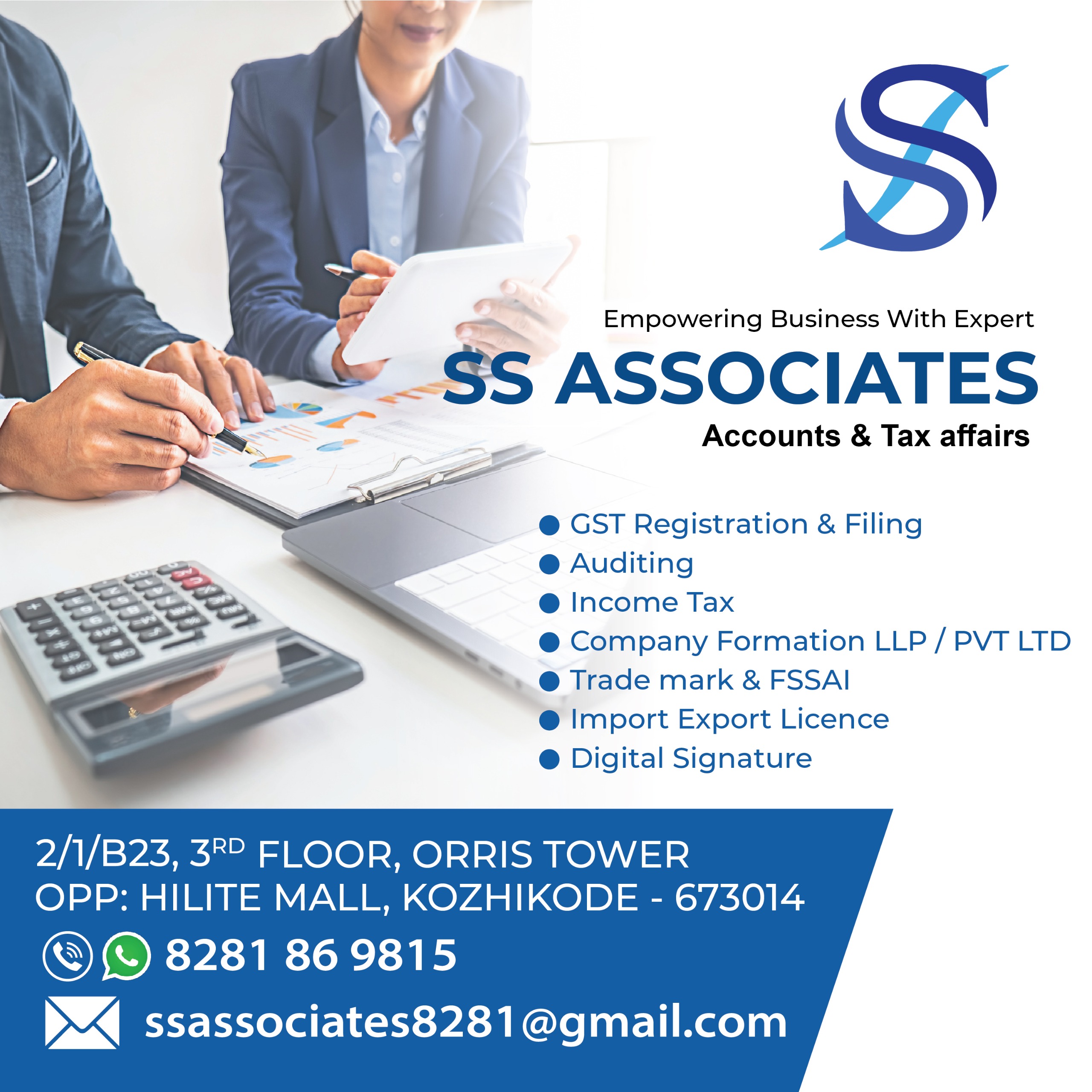
SS Associates

North Kaloor - Ernakulam
Products & Services:
SS Associates, North Kaloor, Ernakulam, Reviews, Contact number, Phone number, Address, Map, Tax Con More..
Since : 2017
North Kaloor - Ernakulam
Products & Services:
SS Associates, North Kaloor, Ernakulam, Reviews, Contact number, Phone number, Address, Map, Tax Con More..
Since : 2017

Below is a curated list of verified ITR filing and income‑tax consultancy firms in Ernakulam / Kochi region with contact details for ease of reference:
SS Associates
Nedungadan Complex, Mathew Paily Road, Behind Town Hall Road, North Kaloor, Ernakulam, 682018
Phone number: +91 8281869815
P.S. Roy & Co.
Cherady Building, I.S. Press Road (North End), Kochi – 682018
Phone number: 0484 2393620
Roy & Associates
Near By Brindhavan Hotel, Palarivattom, Ernakulam
Phone number: 07048730740
TRUE TAX ACCOUNTS & TAX SOLUTIONS
Bank Junction, Aluva, Ernakulam
Phone number: 09725523147
Finways Business Solutions
St Vincent Paul Convent Road, Palarivattom, Ernakulam, 682025
Phone number: 08460255545
Rootbiz Accounting LLP
Vyttila, Kochi, Ernakulam
Phone number: 08511088907
ACCO‑TAX SOLUTIONS
Palarivattom, Ernakulam, 682025
Phone number: 07405044213
Gadegos Solutions Pvt Ltd
Ambelipadam Cross Road, Vyttila, Ernakulam, 682019
Phone number: 09054778971
AJ Associates
Chullickal area, Ernakulam, listed under ITR filing agents
Phone number: 08904887502
Tax / CA Consultants (various small firms around Kochi)
Multiple addresses across Ernakulam (Kadavanthra, Edappally, Kalamassery, etc.)
Phone numbers: as listed in public tax‑consultant directories
TOWNIN.com has listed these as among the most trusted income‑tax return filing and consultancy providers in Ernakulam. Several of the above firms have been added only after verification — either via a field visit or telephonic confirmation — to ensure authenticity and reliability for users seeking professional ITR services in the region.
Corporate
tax filing is a vital responsibility for companies to ensure compliance with
tax regulations and maintain financial transparency. With the implementation of
corporate tax in the UAE, all taxable entities are required to file returns
with the Federal Tax Authority (FTA). This detailed guide explains everything
businesses need to know about corporate tax filing, including procedures,
deadlines, and frequently asked questions.
Corporate
tax filing is the process of submitting a company's financial and tax-related
information to the government for the purpose of calculating and paying taxes
on business profits. In the UAE, the corporate tax law came into effect on June
1, 2023, introducing a 9% tax rate on taxable income exceeding AED 375,000.
All
companies operating in the UAE, whether on the mainland or in a free zone, must
register for corporate tax and file their returns annually, regardless of their
profit status. Even businesses eligible for a 0% tax rate must comply with
filing obligations to remain in good standing with the FTA.
Corporate
tax filing is a critical obligation for every legally registered business.
Beyond fulfilling legal requirements, it plays a fundamental role in financial
transparency, business credibility, and sustainable growth. Filing taxes
accurately and on time helps companies maintain compliance, avoid penalties,
and make informed decisions based on well-documented financial data.
1. Legal Compliance and Penalty Avoidance
Corporate
tax filing is a legal requirement in nearly every country. Businesses that fail
to submit their tax returns on time or underreport their income risk facing
substantial fines, interest charges, and even legal action. Timely filing
demonstrates that a company respects the law and is committed to fulfilling its
financial obligations to the government.
2. Financial Transparency and Strategic Planning
The
process of filing taxes involves organizing and reporting all income, expenses,
assets, and liabilities. This not only ensures accurate tax payments but also
provides the business with a clear picture of its financial health. Regular tax
filing promotes disciplined financial management and helps business owners make
data-driven decisions to support growth and efficiency.
3. Enhanced Business Credibility
Consistent
tax compliance builds trust with stakeholders, including investors, financial
institutions, partners, and government bodies. Companies that maintain proper
tax records and file returns on time are seen as reliable and professionally
managed. This credibility can influence access to loans, investment
opportunities, and large contracts that require financial transparency.
4. Facilitates Global Business Opportunities
For
companies looking to expand internationally, corporate tax compliance is a
must. Many countries and international partners require proof of tax filing
history before entering into agreements or providing permits. A clean tax
record simplifies processes like opening branches abroad, forming joint
ventures, and participating in global tenders.
5. Access to Tax Benefits and Refunds
Filing
taxes accurately allows businesses to claim deductions, exemptions, and tax
credits legally available to them. In cases where the business has overpaid its
tax liability, proper filing ensures that refunds are processed efficiently. It
also supports long-term tax planning, which can significantly reduce the
company’s overall tax burden.
Corporate
tax filing is a legal responsibility for all registered business entities. To
ensure compliance and avoid penalties, companies must understand the
documentation, deadlines, and procedures involved in filing their taxes
correctly. This guide outlines the key requirements businesses must meet when
preparing and submitting corporate tax returns.
1. Legal Business Registration
Before
filing corporate taxes, the business must be legally registered with the
relevant government authority. This includes obtaining a:
Only
legally registered businesses are eligible to file corporate tax returns.
2. Financial Statements and Accounting Records
Accurate
and up-to-date financial records are essential for calculating taxable income
and completing tax filings. Companies must maintain:
These
documents must reflect all income, expenses, assets, liabilities, and equity.
3. Tax Computation Details
Businesses
must calculate their net taxable income by deducting allowable business
expenses from their gross revenue. Requirements include:
This
information forms the basis for computing the corporate tax due.
4. Supporting Documents
Along
with financial statements, companies must retain and, in some cases, submit the
following:
These
documents help substantiate figures reported in the tax return and are crucial
during audits.
5. Auditor’s Report (if applicable)
In many
jurisdictions, especially for medium to large companies, it is mandatory to
have audited financial statements. This includes:
Audited
accounts are often required for tax filings, especially when turnover exceeds
certain thresholds.
6. Filing the Tax Return
Once all
records are in place, businesses must complete the official tax return form.
This typically requires:
The
return must be submitted electronically or via an authorized tax
consultant before the deadline.
7. Payment of Tax Due
Along
with filing the return, companies must pay any tax liability due before
the deadline. This includes:
Proof of
payment is often required as part of the filing process.
8. Filing Deadline Compliance
Each
country sets specific deadlines for corporate tax filings. Businesses must
ensure they:
Missing
deadlines can result in penalties, interest, and even restrictions on future
business activities.
9. Additional Requirements for Multinational
Companies
Companies
with cross-border operations may have to meet additional requirements, such as:
Failure
to comply with international tax obligations can trigger audits and tax
penalties.
Corporate Tax Filing
Deadline and Documents Required for Corporate Tax Filing
Understanding
the deadline and required documents for corporate tax filing is essential for
every business. Timely and accurate tax filing not only ensures legal
compliance but also protects the company from penalties, audits, and
reputational risks. Below is a complete guide to help businesses meet their
corporate tax obligations effectively.
Documents Required for Corporate Tax Filing
Proper
documentation is key to a successful corporate tax filing. The tax authority
uses these records to verify your reported income, deductions, and tax
liability.
1. Basic Business Documents
2. Financial Statements
3. Tax Computation Reports
4. Transaction Records
5. Bank and Accounting Records
6. Additional Tax-Specific Documents
7. Previous Year’s Tax Return
1. Who is
required to file corporate tax in the UAE?
All taxable persons including mainland companies, free zone entities (even if
enjoying a 0% rate), branches of foreign entities, and certain partnerships
must file corporate tax returns.
2. What
is the corporate tax rate in the UAE?
The standard corporate tax rate is 9% on profits exceeding AED 375,000. Profits
up to AED 375,000 are taxed at 0%.
3. How do
I file a corporate tax return in the UAE?
Businesses must file their tax return through the EmaraTax portal of the
Federal Tax Authority. The return should include all relevant financial
information and be submitted within the stipulated deadline.
4. What
happens if I don’t file my corporate tax return on time?
Late filing or non-filing can lead to administrative penalties, fines, and
potential legal action. The FTA may also suspend or revoke the company’s tax
registration.
5. Do
Free Zone companies have to file corporate tax returns?
Yes. Free Zone companies must register and file returns even if they are
eligible for 0% tax under qualifying criteria.
6. Can I
revise a filed tax return?
Yes. If there are errors or omissions in a filed return, a revised return may
be submitted before the FTA completes its assessment.
7. Are
financial audits required for corporate tax filing?
While not all businesses are mandated to submit audited financials, companies
with revenues above certain thresholds or operating in regulated sectors may
need to submit audited financial statements.
8. What
is the penalty for incorrect tax filing?
Penalties may apply for inaccurate or misleading information, underpayment of
taxes, or non-compliance with the UAE Corporate Tax Law. The exact penalty
depends on the severity and intent of the violation.
9. Do
small businesses need to file corporate tax?
Yes. All businesses, regardless of size, must file corporate tax returns.
However, those with taxable income under AED 375,000 are subject to a 0% rate.
10. How
can I get assistance with corporate tax filing?
Professional tax consultants and auditing firms can help with registration,
record keeping, tax planning, and filing services to ensure full compliance
with UAE tax regulations.
Ernakulam, North Kaloor

Ernakulam, North Kaloor
Latest Customer Reviews
"Best GST services in Ernakulam"